Unique technological research
On the coast of the Dutch Wadden Island of Texel are numerous sunken shipwrecks. One of them is the Palmhoutwrak (BZN17), which likely sunk between 1650 and 1660. The ship was named after part of its cargo: palmwood.
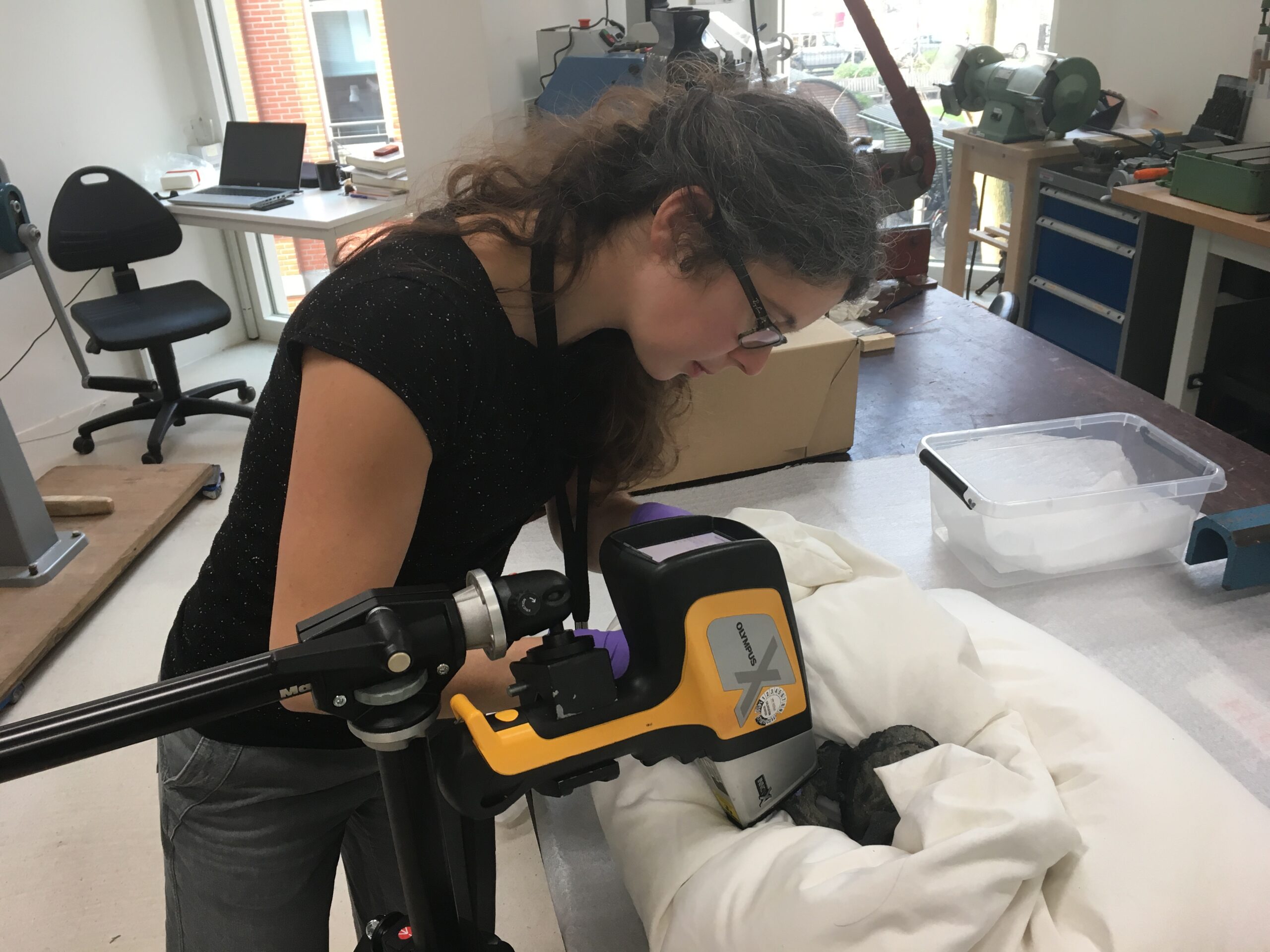
Janneke van der Stok is measuring the composition of a show cup with XRF. Foto by Ernst van der Stok.
AMOR: Archaeological Metal Surface Research
The groundbreaking research on this collection of precious archaeological metals was done within the Dutch National Research Agenda (NWA). This collection of 17th century precious metals found on the wreck is remarkable, the combination of objects is unique, there are no known historical parallels of some of the individual objects, and the metals were found in an unpolished state. Research on these precious metals helps comprehend the connection between them and other artefacts found on the shipwreck.
The innovative technological research of the material used in this research project makes it special. This was made possible by connecting the researchers with the collection holder Provincie Noord-Holland and by collaborating with data stewards. The research project was led by the University of Amsterdam (UvA), in collaboration with the following institutes: Centre de recherce et de restauration des musées de France; AGLAE-facility, Centrum voor Wiskunde en Informatica (Dutch National Research Institute for Maths and Computer Science), Rijksdienst voor het Cultureel Erfgoed (Dutch Cultural Heritage Agency), Rijksmuseum Amsterdam and Technische Universiteit Delft. Effective collaboration between these parties enabled the successful connection with the DANS Data Station Archaeology, granting public access to this unique dataset belonging to this well-known collection.
Successful research method
The authenticity of objects can be determined by examining the process of material change through technological research methods. With a non-invasive internal examination of the objects, researchers gain insight into the past and discover what methods were used to craft the objects. The interdisciplinary collaboration within this project is innovative within scientific research and improves the reusability of data. Sharing, researching and unlocking data on a broad scale allows researchers to interpret data that otherwise can’t be interpreted. Additionally, parallels can be discovered: are there any other similar objects to be found elsewhere?
The applied research methods of this research project contributed to an improved research and conservation strategy after excavating precious metals from an archaeological context. Consequently, developing an interdisciplinary, innovative strategy after excavation is essential for anyone working with precious archaeological metals.
Collaboration with DANS
DANS delivers a valuable contribution to the field of data access in this interdisciplinary collaboration. Material Specialist Janneke van der Stok took part in the non-invasive material research and was responsible for depositing the research data of this project in the Data Station Archaeology. She shares her thoughts on this process: “Honestly, it wasn’t simple to find out where to put which metadata. Which hierarchies are needed to make your files as findable as possible? Because I had to adjust some of these things in hindsight, I now know how to approach this more effectively in the future. Fortunately, I’ve received continuous professional support from Data Processing Team Lead Valentijn Gilissen! Now everyone can access, consult and use the information about these objects and I have gained a valuable experience with DANS.”
Digital archaeology opens doors to large-scale data processing, increasing the visibility of patterns in human activity and spatial development. The DANS Data Station Archaeology offers an infrastructure for depositing and searching through data, essential for future reuse of research data. This e-depot for Dutch archaeology received positive reviews nationally and was internationally awarded with the highest classification for archives by the European Research Council. The CoreTrustSeal-certification makes it a solid service.
Availability of research data
The dataset is made available through the Data Station Archaeology with open license CC-BY-4 and can be found with the following citation: 10. van der Stok, 2025, “AMOR: Archeologisch MetaalOppervlak Research”, https://doi.org/10.17026/AR/BQV0OE, DANS Data Station Archaeology
You can contact Janneke van der Stok through the “Contact Owner” button, for questions about the process of depositing data or the interpretation of the data.
The physical objects are managed by Provincie Noord-Holland, a part of the collection is exhibited in Museum Kaap Skil. Read more about the Palmwood Shipwreck in this report (Dutch) from the Dutch Cultural Heritage Agency.
Both images used for this article are by Ernst van der Stok.