From tapes to Dataverse: forty years as a data bridge-builder
From paper catalogues to digital data communities – a career in motion
Then a small organisation with a big mission: to make social science data accessible. What began as a temporary side job alongside her studies in the sociology of education turned into a four-decade journey through the Dutch (social science) data infrastructure.
On 4 July – her birthday and exactly forty years after her job application – Marion will say goodbye. She looks back on a career marked by growth, unexpected turns, and lasting collegial bonds.
Starting out with grey literature and computer tapes
When she joined the Steinmetz Archive in 1985, Marion’s role focused on acquiring social science datasets. Data arrived on computer tapes, accompanying paper documentation was sent by post, and catalogues were hefty printed volumes. Her task was to screen hundreds of reports – grey literature – in search of promising datasets, then contact researchers by letter.
Marion never followed a fixed career path but seized opportunities as they came. Although she once dreamed of becoming a cancer researcher, her later interest lay in education policy. Not as a teacher – “Although I trained as one, teaching was never for me. You need to be born for that,” she says – but she found education as a social phenomenon deeply fascinating. During her studies in the sociology of education, she came across the vacancy at the Steinmetz Archive – a way to fund her studies. With high unemployment at the time, she applied along with more than 75 others. She got the job and never left.
“At the interview, I naively said that SPSS was my favourite part of the course, but I didn’t think it had anything to do with sociology,” Marion laughs. “At the Steinmetz Archive, all I did was chase down SPSS files.” She immediately felt at home among the computer tapes and data analysis. Her interest in society found an unexpected yet fitting outlet in the world of data services. In those early years, the work was almost detective-like: combing through stacks of reports, hunting for datasets, writing letters, and waiting for replies. “Sometimes, months or even years later, a box of tapes would suddenly arrive – and I’d be proud to have added another dataset to the collection.” Thanks to her sharp eye and perseverance, Marion secured several unique and at the time vulnerable datasets for future use. “What’s great is that many of these are still available today in the DANS Data Station SSH and are still being used.”
With the arrival of email and the internet, her work changed significantly. Where everything once happened by post, communication became quicker and more informal. Catalogues moved online, and the EASY system (around 2005) marked a major shift. “The transition from the Steinmetz Archive to DANS brought huge changes – we went paperless. That took some getting used to, but it had many advantages.” Instead of submitting data via physical tapes and printed documentation, researchers could now deposit their data electronically via EASY. Users no longer had to wait for tapes to be sent – they could download datasets themselves. “For me, this shift also brought a change in focus. I was no longer involved in acquiring datasets but became increasingly engaged in organising symposia and leading projects.”
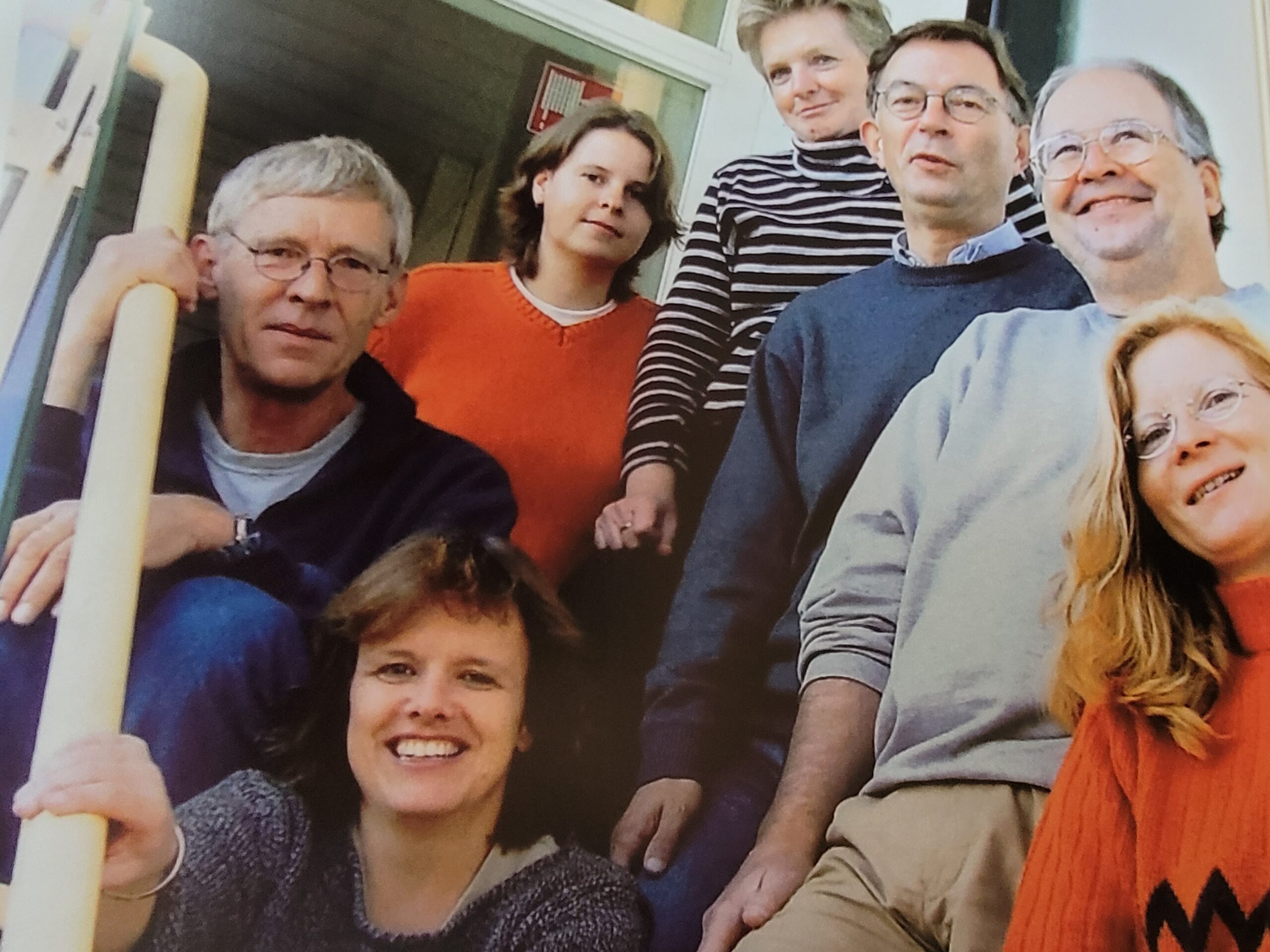
Marion Wittenberg 2004 working for the Steinmez Archief
The common thread: curiosity, initiative and collegiality
Marion’s strength lies in her combination of technical insight and communication skills. Over her forty-year career, she continually developed in both areas. At DANS, she was initially involved in organising guest lectures and symposia in collaboration with researchers. “Those symposia were mainly about how the data could be used – what it could tell you, what kinds of insights it produced.” Later, she joined European projects, particularly for CESSDA, the consortium of European social science data archives. “These projects focused on how best to collaborate across data archives in Europe – how to combine strengths so researchers benefit most.” She adds, “But what I also loved about international projects was the social aspect – working with people from different countries and cultural backgrounds. That’s really enriching.” Her colleagues especially remember her ability to make technical matters understandable – and her patience in helping others move forward step by step.
In recent years, she built a thriving community as service manager for DataverseNL, bridging the gap between user needs and technical implementation. “Growing DataverseNL from 7 to 23 participating institutions is something I’m truly proud of. Listening to what people need and making that happen – that’s what gives me energy.” She always preferred working in a project-based way over managerial roles: close to the content, with a focus on collaboration.
What made the work so enjoyable for her, besides the content, was the people she worked with. “You can have the most interesting job in the world, but it’s the colleagues that make it fun. And I’ve always had that.” These bonds – some dating back to the very beginning – are a treasured constant in her life.
A new chapter: travel, creativity and connection
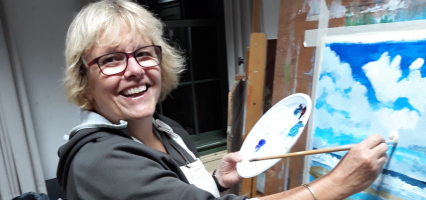
Now that her working life is drawing to a close, Marion’s calendar is far from empty. She’s looking forward to long walks, cycling trips and museum visits. Her creative side is getting a fresh boost, with drawing and painting courses, and woodworking. Two book clubs are also on the agenda. The house and garden will finally get the attention they deserve.
The coming months will be filled with travel – from the Achterhoek and Friesland to Poland and on to Istria in Croatia. After that, she wants to explore opportunities to do volunteer work and give something back to society.
Marion’s forty years at DANS and its predecessors reflect a deep commitment, curiosity and a keen eye for change. Her contributions live on in the systems and communities she helped build – and in the colleagues who worked with her and now continue the work.
With her departure, DANS bids farewell not only to an experienced colleague, but to a dedicated, capable and warm personality. We are grateful to Marion for everything she has brought – to the organisation, the data community and her fellow colleagues.
Thank you, Marion – for forty years of dedication, inspiration and care.