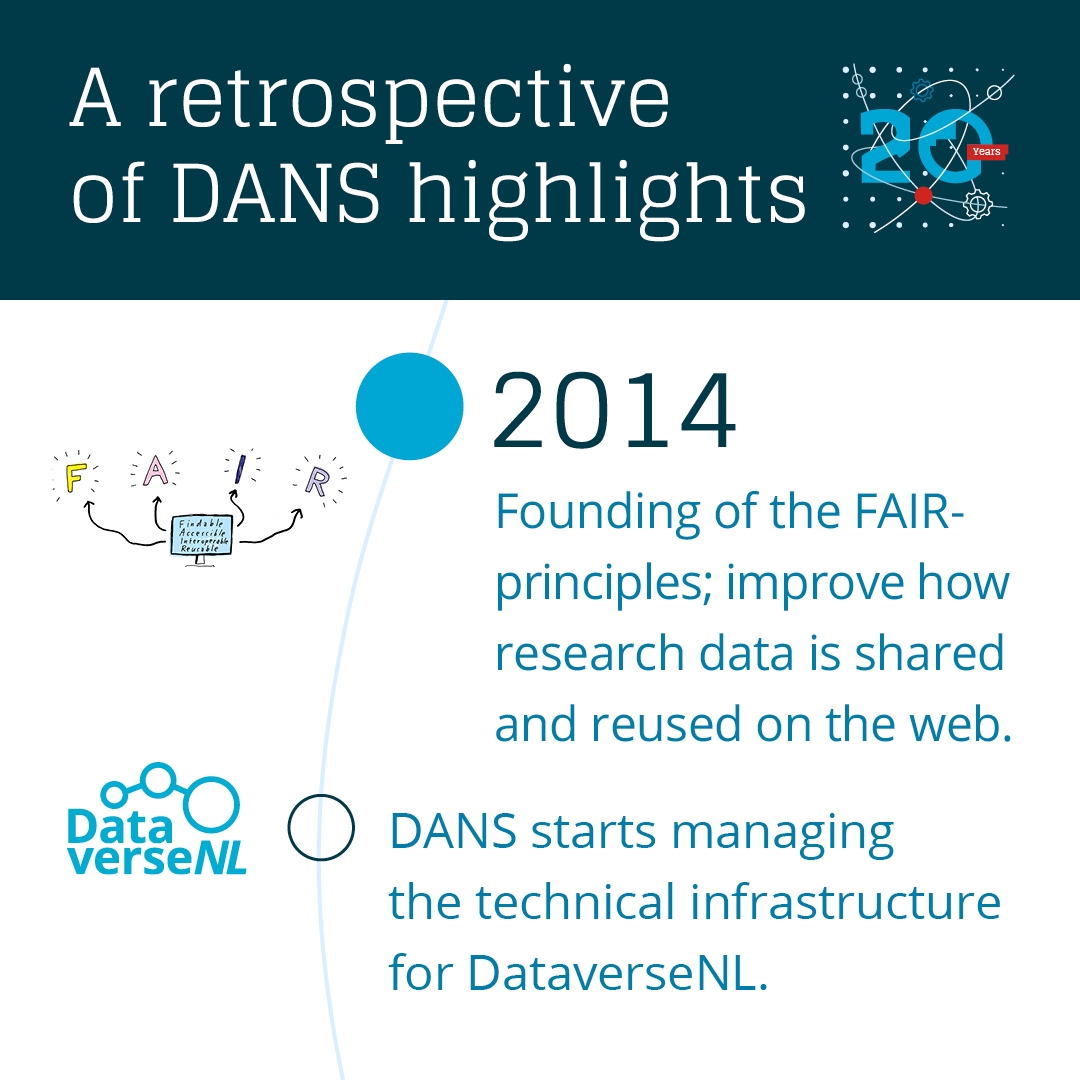
The beginning of FAIR at DANS
When the FAIR principles emerged in 2016, DANS immediately recognised their potential. FAIR was more than a buzzword: it provided a concrete framework for making research data technically sustainable and reusable. From the outset, DANS focused on data quality – not only on whether data are openly available, but also on whether they are structured in ways that enable other researchers to find, understand, and reuse them. This attention to quality, supported by building blocks such as metadata, persistent identifiers (including DOI, ORCID and ROR), clear licences and standardised vocabularies, made FAIR a practical working principle rather than an abstract ideal.
‘Open’ and ‘FAIR’ are often mentioned in the same breath, yet DANS makes a deliberate distinction. While Open Science is a broad concept – encompassing citizen science, open publishing and more – the strength of DANS lies in ensuring reliable, well-structured data. Only then can datasets retain their value, even beyond their original research context.
European collaboration: from FAIRsFAIR to FAIR-IMPACT
The step from principle to practice was largely achieved through European collaboration. As a relatively small organisation, DANS played a leading role in large international projects that helped shape FAIR standards. A key example is FAIRsFAIR (2018–2022), in which DANS and 22 partners developed guidelines, training materials and tools for implementing FAIR within the European Open Science Cloud (EOSC). One of its tangible outcomes was the online tool FAIR-Aware, which enables researchers to assess the ‘FAIRness’ of their data. External reviewers praised FAIRsFAIR for its strong collaboration and lasting impact. Building on that foundation, the follow-up project FAIR-IMPACT (2022–2025) – co-coordinated by DANS – expanded the scope of FAIR across more scientific domains, also addressing software and workflows as essential components of modern data infrastructures.
In an increasingly complex European landscape of initiatives, standards, and infrastructures, DANS has also acted as a connector. Through FAIR-IMPACT and the Research Data Alliance (RDA), DANS has helped reduce fragmentation by aligning knowledge and standards across communities.
Ten years of FAIR: from guideline to reflex
Ten years on, FAIR is no longer an aspiration on paper but an integral part of daily research practice. Researchers, data stewards and institutions use FAIR as a compass for ensuring that data remain accessible and reusable over time. The success of projects such as FAIRsFAIR and FAIR-IMPACT demonstrates how international collaboration can bring together expertise and accelerate progress. Over the past decade, DANS has become a trusted European partner – valued for its expertise, reliability, and consistent delivery. It may not be the largest organisation, but it is one that delivers results.
Looking ahead: building the next phase of FAIR
The future of FAIR presents new challenges and opportunities. Topics such as data sovereignty, sensitive data, and artificial intelligence call for new approaches, where the balance between accessibility and responsibility becomes ever more important. DANS remains committed to strengthening FAIR – by translating international project outcomes into Dutch practice, by investing in new tools and standards, and by fostering collaboration both within and beyond the research community. Twenty years of DANS demonstrate that working sustainably with data begins with vision and persistence.