Working with hard-to-share data?
Researchers in the social sciences and humanities (SSH) often work with data that cannot easily be shared. New guidebooks developed through the Beyond Personal Data project offer practical guidance to help researchers navigate ethical, legal and practical challenges when sharing sensitive data.
Practical guidance for sharing sensitive research data
Not all research data can be shared openly. Besides personal data, datasets may also be sensitive for ethical, cultural, commercial or practical logistical reasons. Field notes from ethnographic research, for example, can include reflections from the researcher or contextual information about participants that requires careful handling.
At the same time, many researchers want to make their data available for reuse in line with the open science principles: as open as possible, as closed as necessary. This raises questions. What can be shared safely? What requires protection? And how can complex qualitative data be prepared for reuse?
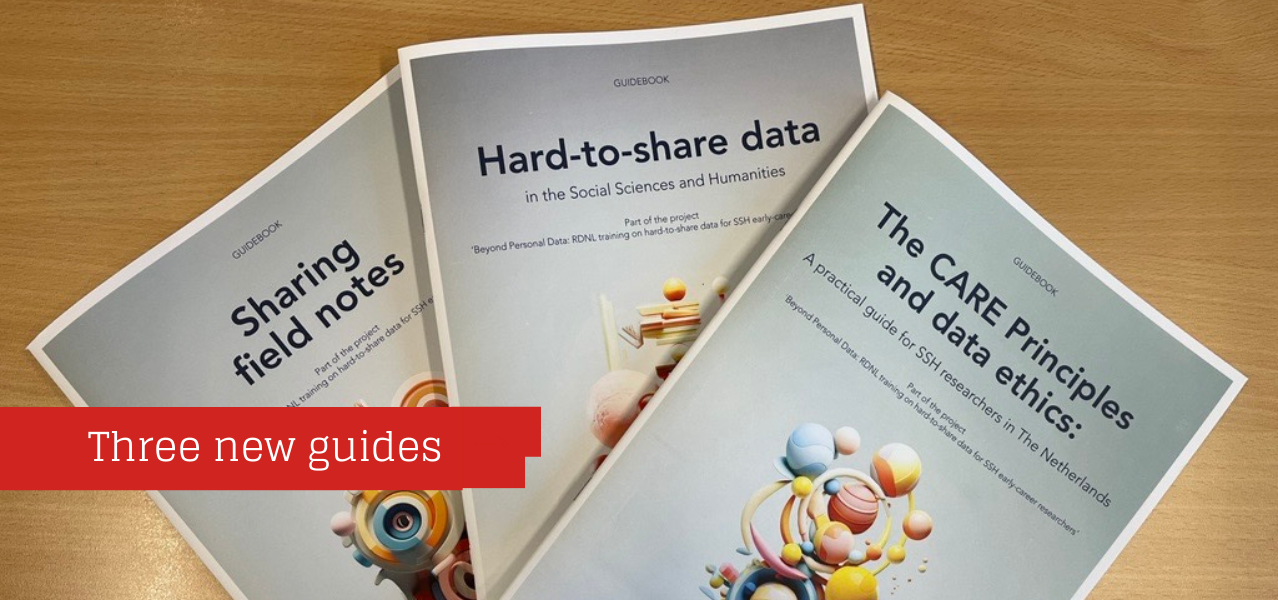
The Beyond Personal Data project developed a series of guidebooks that translate policy and ethical considerations into practical steps researchers can apply in their own projects. The guides focus on non-personal but sensitive data in the social sciences and humanities.
The materials build on three thematic workshops organised for early-career researchers. All associated training materials including lesson plans, slides and exercises, are openly available, enabling reuse in training programmes and research support services.
Three guidebooks for common research challenges
The project produced three guidebooks, each addressing a different aspect of sharing hard-to-share data in SSH research. Together they offer a practical starting point for researchers who want to make their data accessible while respecting ethical and legal boundaries.
Hard-to-Share data in the Social Sciences and Humanities
This introductory guide explains why some datasets are difficult to share and how researchers can enable access in responsible ways. It introduces a broad understanding of ‘sharing’: ranging from controlled access for colleagues to publishing datasets in a trusted repository.
The guide includes case studies and advice from data management specialists. It also explains how secure environments, such as the secure analysis environment (SANE), allow researchers to provide access to sensitive data without compromising confidentiality.
Read this introductory guidebook here, the openly licensed training materials from the workshop can be found here.
Sharing Field Notes
Field notes are an important source in qualitative research across disciplines such as archaeology, sociology and cultural anthropology. They range from handwritten observations in notebooks to structured digital forms.
Because field notes often contain contextual observations, personal reflections or identifiable information about participants, sharing them can raise ethical and legal questions.
This guide explains what field notes are, when can or cannot be shared, and which ethical and legal considerations apply. It also provides practical advice on preparing field notes for publication or controlled access.
Learn more about sharing field notes, read and download the guidebook. The openly licensed training materials from the workshop can be found here.
Ethics of sharing fieldwork data and the CARE principles
Sharing fieldwork data can raise questions about research ethics and the interests of participating communities. This guide introduces the CARE principles and their relevance for Indigenous Peoples’ data governance. It explores how CARE-informed approaches can also inspire responsible data governance in participatory research with marginalised communities. The guide discusses how universities and researchers can integrate these approaches into data management and ethics review processes.
It also offers guiding questions, examples and best practices that help early-career researchers reflect on responsible data sharing in collaboration with communities.
Get an introduction to the ethics of sharing fieldwork data and the CARE principles and find the openly licensed training materials from the workshop here.
Supporting responsible and FAIR data sharing
According to Deborah Thorpe, project member of Beyond Personal Data and Training Coordinator at DANS, responsible data management requires careful consideration when sensitive information is involved.
“Researchers need to balance openness with ethical responsibility. The guidebooks aim to support that process by offering practical guidance for complex issues that researchers encounter in their daily work.
More than 95 participants took part in the workshops, guided by research data specialists and domain experts from several disciplines. which has been a challenging but rewarding process. We hope the materials will become living resources that others continue to reuse, adapt and develop!”
Project Manager Dr. Maithili Kalamkar (SURF) also reflects positively on the collaboration:
“The project explored the challenges of hard-to-share data from multiple perspectives. It was inspiring to see how experts from different organisations and disciplines worked together to address issues that often remain underexplored. We hope the project outputs will be widely used and further developed.”
About the Beyond Personal Data project
Beyond personal data: a new initiative to support early-career researchers with hard-to-share data was a 12-month project funded by the Dutch Research Council (NWO) through the Thematic Digital Competence Centre Social Sciences & Humanities (TDCC-SSH).
The project was led by RDNL consortium partners SURF and DANS, in collaboration with Leiden University, Erasmus University, ODISSEI and the Promovendi Netwerk Nederland (PNN).
Focusing on non-personal sensitive data, the project developed practical guidance on FAIR data practices in situations where ethical, commercial or logistical constraints make data sharing challenging. The project team would like to thank the funders for their support, as well as the speakers and participants who contributed to the workshops.
Social Sciences and Humanities
FAIR and Open dataRDM